

Type B [ ]
]
When repeated measurements do not show any variance or when only one measurement can be taken, a type A uncertainty evaluation is not appropriate. In the case of repeated readings, it probably means that the measurement instruments are not sensitive enough to measure the variance. This does, however, not mean that there is no measurement uncertainty! In these cases, the uncertainty has to be estimated by other means with the help of a list of sources of uncertainty and their estimated quantified contribution to the uncertainty. This is called a ⓘ type Btype B: Evaluation of the uncertainty using other means than statistics. uncertainty analysis.
Sources of uncertainty [ ]
]
To make a list of uncertainty contributions, one starts to look at the experiment and searches for sources of uncertainties. These uncertainties can be classified into several categories: the experimental procedure, the environmental conditions, the measurement instruments, mathematical rounding, and the experimenter self [1, 2]. These uncertainty contributions will have to be estimated and added together to form the "final" uncertainty.
The uncertainty by the measurement instrument itself can be divided into three components: gauge uncertainty (usually indicated on the device), linearization uncertainty (how accurate the markings on a scale are or the digitalization of the instrument is), and the scale uncertainty (the finite number of markings on the scale) [3]. For the scale uncertainty rules of thumb exist for digital and analog instruments:
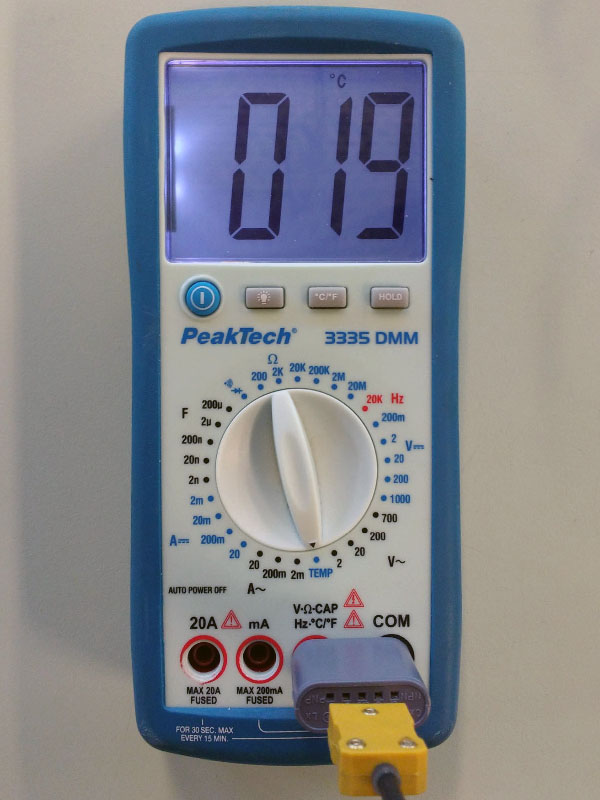
Digital instruments: The uncertainty for a digital instrument is one increment on the scale. For example, see Fig. 7a, suppose a temperature of T = 19°C is measured using a digital thermometer. The instrument has increments of 1°C, thus the scale uncertainty is uscale = 1°C. The reason for choosing one entire increment as uncertainty is because one cannot know how the instrument rounds the values (is the value 7.6°C cut off to 7°C or correctly rounded as 8°C). With that, the measurement result becomes T = (19 ± 1)°C.
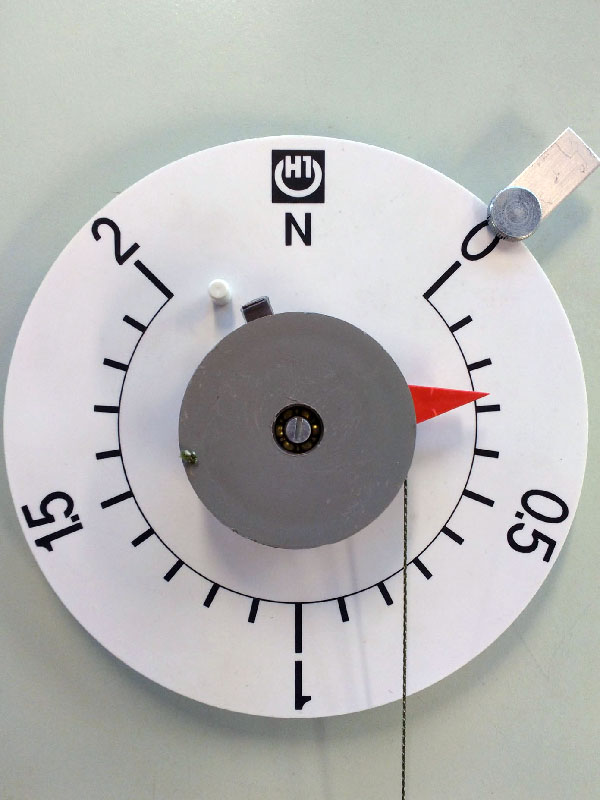
Analog instruments: The uncertainty for an analog instrument is half an increment on the scale. For example, see Fig. 7b, a spring scale measures a force F. The indicator is between 0.2 N and 0.3 N, so the best guess would be 0.25 N. The instrument has markings every 0.1 N, since it is an analog instrument, the uncertainty is uscale = 0.05 N. The reason for this, is that one can determine how to round the reading of the analog scale. So the measurement result is F = (0.25 ± 0.05) N.
Simplification [ ]
]
Most of the time when a type B uncertainty evaluation is performed, one will make practical considerations. For instance, when measuring the time that students take to run a 100 m stretch, one could include an estimated reaction time of 0.5 s.
When taking the measurements as shown in Fig. 7, one could decide to only include the scale uncertainty, but not be bothered with gauge and linearization uncertainties (which are much harder to estimate).
Lastly, one could estimate a range of values in which one could plausibly expect the measurement to be. For instance, suppose that, when measuring the length of a classroom with a 1 m board ruler with 1 cm markings, the ruler has to be shifted eight times. Shifting the ruler will result in an additional uncertainty to the 0.5 cm scale uncertainty. One could decide to include a 1 cm uncertainty for each shift. This will lead to a total uncertainty of 8 · 1 cm + 0.5 cm = 8.5 cm.
Further reading [ ]
]
For further information and some practical examples on the uncertainty of measurement instruments, see Nagel [3].
Literature
- Hellwig, J. (2012). Messunsicherheiten verstehen: Entwicklung eines normativen Sachstrukturmodells am Beispiel des Unterrichtsfaches Physik [Doctoral Thesis, Ruhr-Universität]. http://hss-opus.ub.ruhr-unibochum.de/opus4/frontdoor/index/index/docId/1700
- Hennes, M. (2007). Konkurrierende Genauigkeitsmaße–Potential und schwächen aus der sicht des anwenders. Allgemeine Vermessungs-Nachrichten, 7, 136–146.
- Nagel, C. (2021). Sicher ist sicher! Fachliche Klährung für die didaktische Rekonstruktion von Messunsicherheiten im Unterricht. Plus Lucis, 4, 7–11.